

Name
Johannes Theodorus Polhemius was the first Dutch Reformed minister of Flatbush.[1] He was also called Polheim,[2] suggesting Polhemius was a Latinization of that name. He matriculated at Heidelberg university in 1620 as “Johannes Theodorus Polhemius dictus [called] Hammerstein[,] Boikirchen Westriacus.”[3]
Origin
One known source explicitly mentions Johannes Theodorus Polhemius’s place of origin. In 1620, the Heidelberg university described him as “Boikirchen Westriacus” [from Boikirchen in Westrich]. Westrich was a historical region in the Holy Roman Empire in present-day Germany.[4]
It is uncertain what place Boikirchen refers to, though the name sounds German. In his article about Polhemius, Herbert F. Seversmith stated Boikirchen was “probably in the vicinity of the present Wolfstein in the Palatinate.”[5] In his biographical article about Johannes Theodorus Polhemius, Philip Van Wyck stated the minister was born at “Zweikirchen, on the Lauter River, near Wolfstein.”[6] Wolfstein is about 60 miles from Heidelberg, where Polhemius attended university—a plausible distance. Polhemius first preached in the Palatinate, consistent with being from that area.[7] From 1624 until 1635, he was stationed in various places in Drenthe, the Netherlands, and then in the Palatinate again (see Occupation).[8]
Migration
Johannes Theodorus Polhemius sailed from the Netherlands to Brazil on the Haerlem, which was ready for departure on 18 December 1635. A commissary of the West India Company saw to it that the minister got the cabin to himself and was well-accommodated during his voyage.[9]
In 1654, Rev. Polhemius sailed from Brazil to New Netherland on the St. Charles. Rev. Megapolensis of New Amsterdam wrote to the classis of Amsterdam that Rev. Polhemius had sailed on the same ship as “enige Joden” [some Jews].[10] The timing indicates that was the group of Jews who had arrived on the St. Charles by 7 September 1654.[11]
Settlement
Johannes Theodorus Polhemius settled in Midwout, later known as Flatbush, on Long Island in 1654.[12]
Biographical Details
Johannes Theodorus Polhemius was born in Boikirchen,[13] perhaps Zweikirchen near Wolfstein in the Palatinate (present-day Germany), about 1598. In 1658, two ministers wrote to the classis of Amsterdam about the advanced age of several of the New Netherland clergymen, including Rev. Polhemius who was “already sixty years old.”[14]
Rev. Polhemius died, probably in Flatbush, on 8 June 1676, at about 9 p.m. The “dear, loyal old shepherd and teacher” was buried in front of the pulpit in the baptistry of the Dutch Reformed Church of Flatbush on 11 June 1676.[15] On 27 July 1676, New Amsterdam minister D. W. Nieuwenhuijsen informed the classis of Amsterdam of Rev. Polhemius’s death and the vacancy of the Flatbush ministry that served 300 members of the Dutch Reformed Church.[16]
Marriage and Children
Johannes Theodorus Polhemius first married the widow of a man named Brucherus. In 1635, Polhemius’s stepdaughter Maria Brucheri sued minister Arnold Bottichius of Zuidlaren for breach of promise. She received 50 guilders in compensation.[17] The widow’s first husband was probably Rev. Johannes Brucherus from the Palatinate, who was the minister in Gieten, Drenthe, the Netherlands, from 7 December 1623 and died by 24 July 1624.[18] Johannes Theodorus Polhemius apparently married his predecessor’s widow between 1624 (arrival in Gieten) and 1629 (baptism of first known child), probably in Gieten.
Johannes Theodorus Polhemius was the stepfather of Maria Brucheri.[19] He may also have been the stepfather of Anthonius Brucherus, who dedicated his Disput. Exegetica to Polhemius in 1648.[20]
Child of Johannes Theodorus Polhemius, probably by the widow Brucherus:
- Christina, daughter of Rev. Theodorus Polheim, baptized in the Dutch Reformed Church of Meppel, Drenthe, the Netherlands on 7 October 1629.[21] May have died young as no further information has been found about her.
In 1630, the household of “D. Polheijm” [Rev. Polheijm] in Meppel consisted of four persons.[22] This probably included the minister, his wife, daughter Christina, and another (step)child or servant.
Johannes Theodorus Polhemius married, probably in Brazil by 1642, Catharina van Werven.[23] Van Werven is not a name common in Drenthe,[24] but there were people by that name in Brazil,[25] suggesting the minister met his wife in that Dutch colony. Catharina was still of childbearing age when she arrived in Flatbush in 1656, suggesting she was not the mother of Christina born in 1629. Catharina van Werven died on or shortly before 7 June 1702, when the Dutch Reformed Church of Flatbush received 6 guilders for the use of a shroud for “moeder Pollemes” [mother Pollemes].[26]
Children of Johannes Theodorus Polhemius and Catharina van Werven, birth order largely unknown:
-
Adriana Polhemius, born, probably in Brazil, between say 1637 (last known child in 1682)[27] and 1645 (married by 1659). She married before 12 September 1659 Jan Roelofszen Suebering. On that date, her father gave a power-of-attorney at Brooklyn to his son-in-law “Jan Roeloffs Severing” to handle a payment.[28]
-
Theodorus Polhemius, born at Tamarica [present-day Itamaracá], Brazil,[29] probably between 1638 and 1642 when his father was stationed there,[30] and died, probably at Jamaica, Queens County, New York, between 14 February 1721/2 (will) and 22 May 1722 (probate).[31] He had marriage banns registered in the Dutch Reformed Church of Flatbush on 29 September 1677 and married in Breukelen [Brooklyn] on 14 October 1677 Aartje Anthonis Boogaart from Brooklyn.[32]
-
Daughter, born at Fort Ceulen in Rio Grande, Brazil, 1 February 1648. The West India Company paid Rev. Polhemius six guilders on the occasion of the birth of his daughter.[33] This daughter was not identified further and may have been one of Polhemius’s known daughters at Long Island (see children 5 and 6).
-
Margriet Polhemius, born between say 1637 and 1661 (married by 1677), died around 1701, when she was buried in the Dutch Reformed Church of Flatbush.[34] She married before 17 January 1677 (baptism of child) William Gilliamsz.[35]
-
Anna Polhemius, born between say 1637 and 1661 (married by 1677), married before 17 January 1677 (baptism of child) Cornelius van Wijck.[36]
-
Elisabeth Polhemius, born at Midwood [Flatbush] between say 1657 (a year after her mother’s arrival in Flatbush) and 1666 (married in 1682), died, probably at Flatbush, on 30 September 1683.[37] She married in Midwout (Flatbush) on 22 October 1682 Dionijs Teunisz, son of Teunis Nijssen and Femmetje Jans.[38]
-
Daniel Polhemius, born at Midwood [Flatbush] between say 1657 (a year after his mother’s arrival in Flatbush) and 1665 (married in 1685). He married shortly after 13 August 1685 (marriage intentions) at the Dutch Reformed Church of Flatbush Neeltje Cornelis van der Veer.[39]
On 19 December 1702, Daniel Polhemus received a deed from his brother Theodorus Polhemius and John Seabring, Johannes Williamse, and Cornelius van Wijck as coheirs of “father Polhemus and mother, deceased.”[40] Johannes Williamse was the son of William Gillamsz.[41] Named as joint heirs of both parents, Daniel, Theodorus, Adriana, Margriet, and Anna must have been full siblings.
Education
On 26 January 1620, “Johannes Theodorus Polhemius dictus Hammerstein[,] Boikirchen Westriacus” [Johannes Theodorus Polhemius, called Hammerstein, from Boikirchen in “Westriacus”] matriculated at Heidelberg university in present-day Germany. He studied under Professor Philippus Hoffmann, J.U.D. [doctor in Roman and canon law].[42] The academic title of his professor suggests Polhemius studied law rather than theology, as his later occupation as a minister would suggest. He may have continued his studies elsewhere.
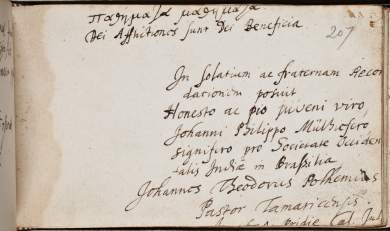
Johannes Theodorus Polhemius would have spoken German while growing up and learned Dutch when he worked as a minister in Drenthe. In Brazil, he also preached in French and Portuguese.[43] Classically educated, he would have read Latin and Greek. He wrote a Latin inscription in the friends’ album of minister Godeschalk Altius in 1634.[44] During his tenure as minister in Tamarica (circa 1638–1642) he wrote a Greek and Latin inscription in the friends’ album of Johann Philip Mulheiser, an ensign working for the West India Company in Brazil, “as consolation and a token of fraternal remembrance.”[45]
Enslavement
While stationed at Brazil, Rev. Polhemius owned several enslaved people. Seversmith speculated that he may have exploited their labor for a sugar plantation.[46] Rev. Polhemius did indeed own a plantation during his time in Brazil, on the island Itamaracá. A 1648 map of the island shows its location, marked “alhier heeft Dome Pholemus plantagie gestaen” [here was located Rev. Pholemus plantation]. The plantation lay on the Rio Carmahou [Carmahou river] on the south side of the island.[47]
On 24 March 1639, the West India Company transferred an enslaved man named Curacio to Rev. Polhemius at Tamarica [Itamaracá]. The company charged Polhemius 210 “patacques,” a type of silver coin, which was deducted from his account.[48]
On other occasions, minister Polhemius bought enslaved people who had been recently transported from Africa. On 25 February 1642 he bought two enslaved people for 700 guilders.[49] On 29 May 1643, Polhemius paid 225 guilders for one enslaved person who had been transported from Guinea to Brazil on the Swarten Arent [Black Eagle].[50] On 22 September 1643, Polhemius purchased five of the 211 Black people who had been transported from Luanda, a Dutch outpost in present-day Angola, to Brazil on the Moriaen [Moor]. They were parcelled into lots, assigned lot numbers, and sold at public auction. Polhemius paid 660 guilders to buy the enslaved people identified as lot number 55.[51] He bought a further six enslaved people in January 1644 for 993 guilders and 12 stivers. They had been transported from an unidentified location on the Poortier [Gatekeeper], Groote Gerrit [Big Gerrit] and Swaen [Swan] and auctioned off between 18 and 20 January 1644.[52]
On 25 May 1645 the minister sold six Black people and three Black children for 2200 guilders to Servaes Carpentier. He also sold him the rights to eight more Black people who had fled into the woods for 257 guilders per person.[53] The sale of the people he enslaved suggests Polhemius gave up his plantation at this time, perhaps because he moved to Rio Grande.[54] That explains why the 1648 map mentioned the former location of his plantation.[55] On 2 May 1662, Polhemius still had not received payment for the sale of the enslaved people, and authorized someone to collect the debt on his behalf.[56]
Occupation
Rev. Johannes Theodorus Polhemius was a minister in the Dutch Reformed Church. According to D. L. Noorlander, Polhemius was the West India Company’s longest-serving minister.[57]
Rev. Polhemius served different congregations in the Palatinate and the Netherlands. He served as minister in Gieten 1624 to 1627.[58] In 1627, he was appointed to fulfill the position of second minister in Meppel.[59] In 1629, he received 250 guilders for filling that post, and for being the headmaster of the Latin school in that location.[60] By 1633, he received 750 guilders per year for those functions.[61] On 3 December 1635, Rev. Johannes Theodorus Polheim appeared before the classis of Amsterdam. He stated he had been a minister in the Palatinate, then in Meppel, and again in the Palatine, which he had had to leave for the second time because of persecutions. He requested to be sent to the West Indies. After reading testimonials from Meppel and Gieten, the classis accepted his call.[62]
Rev. Polhemius served in the Dutch colony in Brazil from 1636 until 1654, when the Portuguese reconquered the colony. He was initially stationed in Pernambuco, Brazil in 1636.[63] He then served at Cabo St. Augustin in Brazil until 1638, when he was called to serve at Tamarica [Itamaracá], an island off the coast of Brazil.[64] At Tamarica, he met three Brazilians, who asked to be instructed in Christianity. Polhemius had begun to learn Portuguese and wanted to visit them.[65] In May 1638, Polhemius went on a mission to Goyana [Goiana, Brazil].[66] In 1642, Polhemius served in Goiana. He complained that his “ziekentrooster” [comforter of the sick, a lay clergyman] had quit his position and a new person was sent in his stead, all without informing him.[67] Goiana had no parsonage, and he received an extra 18 guilders per month for housing.[68]
In 1643, he was called to serve in the Dutch colony of Angola in Africa, though it is doubtful he ever worked there, since he continued to trade in Brazil.[69] Around 1646, he was transferred to Rio Grande. A fellow clergyman complained to the classis that Polhemius did not take up residence at Fort Ceulen at Rio Grande, but rather in a village about 15 miles away, to live among the Brazilians even though he did not speak the language.[70]
In May 1648, Polhemius informed the Brazil classis that he had served at Rio Grande for two years, at great peril and personal expense, and requested a transfer to Recife. The classis promised to consider him for the next vacancy.[71] However, later that year he transferred to Paraiba. His wife owed the commissary at Rio Grande 112 guilders and 9 stivers for groceries, which the minister asked the West India Company to pay and put on his account.[72]
Polhemius periodically attended meetings at the classis of Brazil held in Recife de Pernambuco. On 5 January 1638, Polhemius was elected as “scriba” [scribe, secretary] of the classis. The classis discussed a range of topics, including personnel shortages and transfers, the conversion of Brazilians, and wages of the clergy.[73]
After Brazil was taken over by the Portuguese in 1654, the family had to flee. Rev. Polhemius went to New Netherland while his family ended up in Amsterdam. In October 1654, he started preaching in Midwout (Flatbush), on Long Island, where he initially served without pay.[74] The magistrate from Midwout and Amersfoort wanted him to stay on.[75] The directors of the West India Company had no objections, as long as the congregation would pay the salary.[76] A poll of parishioners showed they were willing to pay 600 guilders, which was sufficient to prevent the minister from leaving.[77]
On 15 October 1654 Rev. Polhemius gave power of attorney to his wife Catharina van Werven to collect 4,910 guilders and 10 stivers that the West India Company owed him for his service in Brazil.[78] By 26 May 1656, the minister had decided to stay in New Netherland and requested that his wife and children join him there. The classis of Amsterdam advised them against making the dangerous voyage, but she desired to be with her husband and was living in poverty in the Netherlands.[79] On 14 June 1656, West India Company advanced her the money to travel to New Netherland with her children on the Gulden Otter, charged against the minister’s account.[80]
The towns of Midwout and Amersfoort wanted to build their minister and his family a proper parsonage and fenced a plot of land for his use. On 15 June 1655 they requested permission to hold a collection. The director-general and council wanted to see the account first.[81] In 1656, the director-general and council sent planks to use in the minister’s house, but several were misplaced and misappropriated. The minister complained that his house remained open and that he and his family had to sleep in the cold on the ground.[82]
In the early years of Rev. Polhemius’s service in Midwout, the town did not yet have a church. Apparently the congregation held services in the home of its minister. In 1669, three napkins and a tablecloth that had been used for the service of the Lord’s Supper were still at the minister’s house, although they belonged to the deaconry.[83]
As minister, Rev. Polhemius monitored the moral behavior of his parishioners and fellow clergymen. On 11 September 1663, he wrote to the classis of Amsterdam about a case of adultery between the daughter of Rev. Gideon Schaets and a married man.[84]
Rev. Polhemius held separate services in Brooklyn between 1656 and 1660. In February 1656, Breuckelen demanded that if they had to pay for the minister’s salary, they should have their own services, with Rev. Polhemius preaching at both Midwout and Breuckelen. The director and council agreed.[85] On 7 April 1656, Rev. Polhemius came to an agreement with the towns of Breuckelen (Brooklyn), Midwout, and Amersfoort to act as their minister.[86] However, the town of Breuckelen did not feel they were sufficiently consulted, and initially refused to contribute after the first year.[87] Some residents of Breuckelen even refused to pay for the first year.[88] When Breuckelen called its own minister, Rev. Polhemius stopped preaching there after 30 August 1660. The 300 guilders for his services in that town were reassigned to Rev. Selijns.[89]
In 1665, the residents of Amersfoort wanted Rev. Polhemius to hold separate services in their town. The minister indicated that that would be more work, which would require more compensation.[90] Governor Nicolls found the town’s request reasonable, weather permitting, and urged the parties to come to an agreement.[91] The town of Midwout decided that instead of paying more, they would dispense with the services of the minister, and make do with a reader instead. They mentioned Rev. Polhemius’s lack of talent, the poor example he set, and the evil conversation he promoted among the parish.[92] However, he was still working as a minister in Flatbush (Midwout) in 1672.[93]
Money was a constant concern for the Flatbush minister. Before Rev. Polhemius received regular wages, he repeatedly called upon the director and council for monetary assistance, against the balance of his account. In November 1654, he received 30 guilders in wampum.[94] In December 1656, Rev. Polhemius could not pay the first term of a parcel of land he bought, and the council had to pay 100 guilders on his behalf.[95] By 17 April 1657, the minister still had not received his wages and received 60 guilders to pay a debt to Oloff Stevensz—less than the 100 guilders he had asked for.[96] On 29 January 1658, Rev. Polhemius came to an agreement with the council that the 942 guilders they had advanced him over the years would be remitted, as payment for his services as minister from October 1654 until 7 April 1656.[97] In 1663, minister Polhemius asked the town of Midwout for an increase in his salary. The town refused, but exempted him from paying excise and security taxes.[98] Governor Francis Lovelace confirmed in 1670 that the minister’s property should not be taxed.[99] In 1672, the constable of Flatbush, as Midwout was called after the English conquest, withheld 150 guilders from the minister’s salary.[100] The court ordered the constable to pay in 1676, but he still had not done so by 1678, when Rev. Polhemius’s widow appealed to the New York governor to finally receive what she was owed.[101]
Holdings and Estate
Rev. Polhemius owned a plantation on the island Itamaracá in Brazil.[102] After Brazil was taken over by the Portuguese, the minister lost his investments. For years, he tried to recoup his losses and submitted a claim to a compensation fund. In 1661, he requested 1800 guilders compensation for a cane sugar field that he had sold in 1645 for 1000 guilders, plus sixteen years interest.[103] In 1663, he tried again, this time only for the principal.[104] However, in 1672, the Dutch government determined he had failed to provide enough evidence and denied his claim.[105]
On 25 January 1662, Johannes Theodorus Polhemius received a patent from Governor Petrus Stuyvesant for a double lot of land in Flatbush. The land was surveyed in 1680, when Governor Andros confirmed the patent to Catherina, the minister’s widow. It measured 23 morgen and 420 rods. Rev. Polhemus obtained an additional 24 morgen 420 rods from Johannes Seabring [his son-in-law Jan Roeloffszen Suebering] on 6 March 1674 (originally granted to Cornelius Swartwout). In total, the widow owned 52 morgen, 4 acres, and 360 rods of land. The lots were located on the south by southeast side of the lane and on the north by northwest side of Peter Lott.[106] On 12 November 1677, Governor Andros confirmed that the widow and children of J. T. Polhemius were entitled to the land at Flatbush that the minister had left them.[107]
These two lots were probably located near the third kill at Flatbush. On 2 February 1670 several neighbors of minister Polhemius received patents for land in that part of Long Island.[108] That land was separate from the land that the Director-General and Governor of the colony made available for the minister’s use.[109] Rev. Polhemius also owned several meadows in the area around Flatbush. On 21 April 1667, the town laid out several meadows at Canarsie and awarded them to settlers by lottery. Rev. Polhemius received the lots numbered 7 (jointly with captain Jeffers) and 10.[110] A list of meadows at the Fresh Kill from around 1667 shows Rev. Polhemius owning lot 20.[111] On 6 August 1668, Jan Suebering and Rev. Polhemius together received three lots in Canarsie and Fresh Kills.[112]
Church Membership
Johannes Theodorus Polhemius was a minister in the Dutch Reformed Church.[113]
Associations
Support New Netherland Settlers
Help us support New Netherland Settlers and further more research and additional sketches.
Do you have a New Netherland ancestor that should be included or other information to contribute to the initiative? Please email development@nygbs.org with the subject line "NNS Information," and we will follow up with you.
Rev. Polhemius often interacted with other ministers in New Netherland, including Johannes Megapolensis, Samuel Drisius, Henricus Selijns, and Gideon Schaets. In his work for the Midwout church, he worked closely with the elders and deacons, including Jan Snedeker and Jan Strijcker.[114]
Additional Details
While serving in Brazil in 1653, Rev. Polhemius borrowed 1500 guilders against his balance at the West India Company. On 21 March 1660, Amsterdam merchant Abraham Cohen declared that he had been repaid in full. Polhemius’s son-in-law, Jan Roelofszen Suebering, had arranged the payment.[115]
In Midwout, Rev. Polhemius was involved in several court cases regarding livestock. On 7 April 1660, Aeltjen Douwens, the wife of Lowijs Jansen, claimed that her boar was running with Rev. Polhemius’s hogs. The court found it unclear who the owner was and ordered the minister to let the boar go, and the town would pay him ten guilders.[116] This solution saved the minister the embarrassment of a verdict that made him look like a thief. In 1665, Gerret Snedeker sued the minister, claiming that the minister’s ox had gored one of his sows. He demanded compensation and produced a witness who saw the ox killing the sow. The outcome of the case was not recorded.[117]
On several occasions, Rev. Polhemius went to court to recover money owed to him. On 13 January 1662, he had attached property in the hands of Dirck Jansen, cooper, for a debt owed by Engelbrecht Stienhuijsen. Stienhuijsen owed the minister 14 guilders for salary.[118] On 27 February 1665, Rev. Polhemius attached property in the hands of Claes Milles for a debt of 22 guilders and 10 stivers owed by Gerret Cornelis for the sale of a goat.[119]
Literature
Bailey, Rosalie Fellows. “Signatures of Flatbush, L. I. Settlers: I.” Halve Maen 38 (1963): 9–10, 12. Discusses biographical information about Rev. Polhemius, one of the signers of a contract between Midwout church officials, town officials, and Reijnier Baestiaensen van Giesen to serve the church, teach the school, and dig graves.
Blauvelt, Ralph. Four Hundred Years in America: Seventeenth Century Immigrant Ancestors. Blauvelt Productions, 2021. The chapter on Johannes Theodorus Polhemius and Catharina Van Werven (pp. 135–42) contains a biographical sketch with translations of relevant records, and maps showing the locations of property owned by the minister.
Clayton, J. Wilbur, I. Lester Bedell, and John H. Overturf, compilers. History and Geneaology [sic] Polhemus, Woolley, Totten, Clayton, Bedell. Ohio, 1954. Discusses various publications about families named Polhemus and variations. Includes details about Johannes Theodorus Polhemius, but mistakenly has his place of birth as “Mepple” in Drenthe.
Cortelyou, John V. The Ancestors of Two Sisters: Records of the Ancestors of Helen Robina Cortelyou and Carol Van Zandt Cortelyou. Brown Printing Service, 1954. Discusses Johannes Theodorus Polhemius as ancestor no. XI-15 (pp. 97–98); does not cite any sources.
De Boer, Louis P. “Pre-American Notes on Old New Netherland Families.” Entry “Polhemus.” Genealogical Magazine of New Jersey 3 (1928): 102–08. Describes the history of the Polhemus family back to the year 1073 CE, without offering any reasoning to connect that family to Rev. Johannes Theodorus Polhemius.
Eekhof, A. De Hervormde Kerk in Noord-Amerika (1624–1664). Martinus Nijhof, 1913. See especially chapter 8, about the Dutch Reformed parishes on Long Island.
Justice, Alfred Rudolph. Wilson and Allied Families: Billew, Britton, DuBois, Longshore, Polhemus, Stillwell, Suebering. Philadelphia, Pennsylvania: 1929. Chapter on Polhemus family (pp. 136–39) contains a coat of arms of the family, from Rietstap, without evidence of a connection to the minister’s family. Contains a biographical sketch of Johannes Theodorus Polhemius including a list of six children.
Loosse, L.J. “Polhemius (Polheim), Johannes Theodorus.” Biografisch Lexicon voor de geschiedenis van het Nederlandse Protestantisme. Vol. 6. Kampen, Netherlands: Kok, 2006. The entry for Johannes Theodorus Polhemius (pp. 232–33) discusses his role in the church, including his efforts to make the church wardens accountable to the ministers in Drenthe, and his pleas for evangelization among the Native American population in Brazil and the English in New Netherland.
Noorlander, D. L. Heaven’s Wrath: The Protestant Reformation and the Dutch West India Company in the Atlantic World. New Netherland Institute Studies. Cornell University, 2019. Discusses Polhemius’s work as minister in Brazil and New Netherland (pp. 31, 117, 187, 209–10). The book also goes into wider themes such as the views of the Dutch Reformed Church and the West India Company towards colonization and slavery.
Nooter, Eric. “Between heaven and earth: Church and society in pre-revolutionary Flatbush, Long Island.” Ph.D. Dissertation. Vrije Universiteit Amsterdam, 1994. Imaged. ProQuest Dissertations & Theses. https://www.proquest.com/pqdtglobal/docview/304125602/. No. 9524387. Extensive, well-documented discussion of the history of the Dutch Reformed Church of Flatbush, including the role of Rev. Polhemius as their first minister and the financing of his salary.
_____. “Between Heaven and Earth: The Dutch Reformed Church in Flatbush Society, 1654–1664.” De Halve Maen 66 (Winter 1993): 66–74. Discusses Polhemius as the first minister of the Dutch Reformed Church of Flatbush.
Peck, I. Heyward. “The Rev. Johannes Theodorus Polhemius and Some of His Descendants.” New York Genealogical and Biographical Record 90 (April 1959): 65–80, (July 1959): 171–75, (October 1959): 225–39, 91 (January 1960): 29–39, (April 1960): 90–98, (July 1960): 174–79, (October 1960): 204–21, 92 (January 1961): 50–53, (April 1961): 105–18, (July 1961): 161–74. Detailed, well-documented discussion of the minister’s life, with many English translations of relevant records. Peck had 9 September 1676 as the death date of Polhemius (p. 66) rather than 8 June 1676. Suebering’s April 1660 voyage on the Bonte Koe must have been his return voyage to New Netherland, rather than his initial arrival as claimed by I. Heyward Peck. Peck estimated Adriana’s marriage date as 1661 based upon Suebering’s supposed arrival in New Netherland 1660 (p. 171).
Riker, James. The Annals of Newtown, in Queens County, New York; Containing Its History from Its First Settlement, Together with Many Interesting Facts Concerning the Adjacent Towns. D. Fanshaw, 1852. Entry for “The Polhemus Family” (pp. 348–50). Riker stated that Rev. Polhemius stopped working for the Flatbush church in 1665 but kept working in Brooklyn until his death in 1676. However, that is not consistent with the finding that Rev. Selijns took over preaching in Brooklyn in 1660.
Romein, T. A. De Hervormde Predikanten van Drenthe, sedert de Hervorming tot in 1861. Groningen, Netherlands: Oomkens, 1861. Sections about J. T. Polhemius as minister in Gieten (p. 69) and Meppel (p. 146).
Rutherford, William Kenneth, and Anna Clay (Zimmerman) Rutherford. Genealogical History of Our Ancestors. 2 vols. 1977. The chapter about the Polhemus family (1:620–29) discusses the minister’s life and seems to be largely based on the articles by Seversmith (1955) and Peck (1959). More genealogical details about ancestors and descendants are included in the second volume (2:522–28), again largely based on the earlier works.
Seversmith, Herbert F. “The Dominy Johannes Theodorus Polhemius of Flatbush, Long Island.” National Genealogical Society Quarterly 43 (December 1955): 125–30. The article includes speculation about the father and further ancestors of Johannes Theodorus Polhemius. The author believed Johannes Theodorus Polhemius was the son of Johann Theodor Polhemius, a schoolteacher at Dorn-Dünkheim (1606–1610) and Godramstein (1610–1611) who lived at Boikirchen in 1602. None of the references explain where he found this information.[120]
Shefsiek, Kenneth. “Ecclesiastical Independence and Ministerial Debasement in Dutch Reformed New Netherland: The Case of Rev. Johannes Polhemus.” The Journal of Presbyterian History 100, no. 2 (2022): 56–71. Discusses the financial situation of Rev. Polhemus and his relation to the Classis of Amsterdam.
Van Voorhees Association. Through a Dutch Door: 17th Century Origins of the Van Voorhees Family. Baltimore, Maryland: Gateway Press, 1992. Discusses Rev. Polhemius in the context of a group of New Netherland settlers from Drenthe.
Van Wyck, Philip. “Johannes Theodorus Polhemius.” Halve Maen 55 (Summer 1980): 9–13, 19–21. This detailed biographical sketch does not cite its sources. It mentioned a daughter Lammatje, supposedly born at Itamaracá,[121] but this information has been disproven. As noted by Mrs. John M. Spell, Johannes Theodorus’s grandson Johannes Williamse/Willemse married Lammetje Brinckerhoff. Lammetje (Brinckerhoff) Polhemius’s appearance in a 1702 deed caused prior researchers to assume she was Rev. Polhemius’s daughter.[122]
Welles, Theodore W. Ancestral Tablets from Colonial Days to the Present Era: A Record of the Descendants of Gov. Thomas Welles of Connecticut, Capt. Gerrit Janse Hardenbergh of New York, Fiscaal Hendrick van Dyck of New Amsterdam, Jan Tysse Goes of Beaverwyck, and Nearly One Hundred Allies Families. Press Printing and Publishing, 1893. Contains an undocumented sketch of the Polhemius family that mentioned daughters Lammetje (wife of Johannes Wellemse) and Catrina, without documentation. However, Johannes Wellemse was rev. Polhemius’s grandson, not his son-in-law. Catharina Polhemius appears in various records, but was likely Catharina van Werven, the wife of Johannes Polhemius, rather than his daughter. No evidence was found for a daughter Catrina/Catharina.
Wiltsee, Jerome. A Genealogical and Psychological Memoir of Philippe Maton Wiltsee and His Descendants: With a Historical Introduction Referring to the Wiltsee Nation and Its Colonies. 1908. Contains a sketch of “Jahonnes [sic] Theodorus Polhemius and his descendants” (pp. 95–96). Includes undocumented speculation about ancestors in Antwerp and Ghent. Wiltsee has Rev. Polhemius arriving in New Netherland in 1652, two years before original records place him there.
Source Editions
Classicale acta van Brazilië. N.p., 1874. Numerous references to Rev. Polhemius in the minutes of the Dutch Reformed Classis in Brazil.
Christoph, Peter R., and Florence A Christoph, eds. Books of General Entries of the Colony of New York, 1664–1673: Orders, Warrants, Letters, Commissions, Passes and Licenses Issued by Governors Richard Nicolls and Francis Lovelace. Genealogical Publishing, 1982. Tax exemption (p. 397).
Christoph, Peter R., and Florence A Christoph, eds. Books of General Entries of the Colony of New York, 1674–1688: Orders, Warrants, Letters, Commissions, Passes and Licenses Issued by Governors Sir Edmund Andros and Thomas Dongan, and Deputy Governor Anthony Brockolls. Genealogical Publishing, 1982. Confirmation of estate to widow and children (p. 193).
_____. The Andros Papers: Files of the Provincial Secretary of New York During the Administration of Governor Sir Edmund Andros. Translated by Charles T. Gehring. Vol. 1, 1674–1676. Syracuse University Press, 1989. Salary of Rev. Polhemius (p. 93).
_____. The Andros Papers: Files of the Provincial Secretary of New York During the Administration of Governor Sir Edmund Andros. Translated by Charles T. Gehring. Vol. 2, 1677–1680. Syracuse University Press, 1990. Money owed to the widow of Rev. Polhemius (pp. 263–64, 270–71, 401).
Gehring, Charles T., ed. Correspondence, 1654–1658. Syracuse, New York: Syracuse University Press, 2003. Letters about arrival of Rev. Polhemius from Brazil (p. 52) and of his family’s voyage (p. 96).
_____. Council Minutes, 1652–1654. Baltimore, Maryland: Genealogical Publishing, 1983. Petition from Midwout and Amersfoort regarding minister (p. 185).
_____. Council Minutes, 1655–1656. Syracuse, New York: Syracuse University Press, 1995. Various correspondence regarding Rev. Polhemius’s position as minister, payments for his services, and provisions for his house (pp. 16, 56–57, 70, 238–39, 285).
Gehring, Charles T., and Janny Venema, eds. Council Minutes, 1656–1658. Syracuse, New York: Syracuse University Press, 2018. Various correspondence regarding Rev. Polhemius’s position as minister, payments for his services, and provisions for his house (pp. 174-75, 181-82, 203-9, 233-34, 238-40, 267-68, 293, 378).
Hastings, Hugh, ed. Ecclesiastical Records, State of New York. 7 vols. Albany, New York: James B. Lyon, 1901–1916. Numerous references to Rev. Polhemius (see index).
Oppenheim, Samuel. The Early History of the Jews in New York, 1654–1664: Some New Matter on the Subject. 1909. Transcription and translation of extract from letter of Rev. Megapolensis mentioning the voyage of Rev. Polhemius to New Netherland (pp. 73–74).
Scott, Kenneth, and Kenn Stryker-Rodda, eds. Register of the Provincial Secretary, 1648–1660. Translated by Arnold J. F. Van Laer. Vol. 3. Baltimore, Maryland: Genealogical Publishing, 1974. Power of attorney from Rev. Polhemius to his wife (pp. 376–77).
_____. The Register of Salomon Lachaire, Notary Public of New Amsterdam, 1661–1662. Translated by E. B. O’Callaghan. Baltimore, Maryland: Genealogical Publishing, 1978. Sale of enslaved people in Brazil (pp. 140–42).
Van der Linde, A. P. G. Jos, ed. Old First Dutch Reformed Church of Brooklyn, New York: First Book of Records, 1660–1752. New York Historical Manuscripts: Dutch. Genealogical Publishing, 1983. Several references to J. T. Polhemius as minister of Brooklyn, including notes about his death (pp. 98–99, 156).
Venema, Janny, ed. Correspondence, 1659-1660. Syracuse, New York: Syracuse University Press, 2022. Salary due to Rev. Polhemius (pp. 17, 71, 149, 244).
Voorhees, David William. Records of the Reformed Protestant Dutch Church of Flatbush, Kings County, New York. Vol. 2, Deacons' Accounts, 1654–1704. Holland Society of New York, 2009. Several references to J. T. Polhemius as minister of the church.
Citations
[1] Petition from Midwout and Magistrate regarding employment of Rev. Polhemius, 13 October 1654, in New Netherland Council, Dutch colonial council minutes, vol. 5, 1652–1654, p. 376–77; imaged, “Digital Collections,” New York State Archives (https://digitalcollections.archives.nysed.gov/index.php/Detail/objects/54925), identifier NYSA_A1809-78_V05_0376b; citing series A1809: Dutch Colonial Council Minutes, New York State Archives, Albany, New York.
[2] Johannes Theodorus Polheim request to be sent to the West Indies, 3 December 1635, in Dutch Reformed Church, Classis of Amsterdam, regulations and members, 1631–1646, fol. 66; imaged, Gemeente Amsterdam Stadsarchief (https://archief.amsterdam/inventarissen/file/92ae47d1-24ea-34ad-c96f-88d28eedaba0), image 54 of 221; citing call no. 4, Record Group [RG] 379: Archief van de Nederlandse Hervormde Kerk, Classis Amsterdam [Archives of the Dutch Reformed Church, Classis Amsterdam], Stadsarchief Amsterdam, Amsterdam, Netherlands.
[3] Matriculation of Johannes Theodorus Polhemius, 26 January 1620, in University of Heidelberg, “Matrikel der Universität Heidelberg” [matriculation register of the university of Heidelberg], 1579–1662, fol. 152v, entry 6; imaged, “Digital Library,” Universitätsbibliothek Heidelberg (https://doi.org/10.11588/diglit.17558#0308); citing UAH M4.
[4] In the medieval period, the name Westratia or Westrich indicated the western part of the Holy Roman Empire, but by the 1600s it had come to mean a more specific region in the west of present-day Germany. See for example Matthäus Merian, ed., Topographia Palatinatus Rheni et eicinarum Regionum (Frankfurt am Main, Germany: 1645), which describes “Wessterreich” as being in the vicinity of the Palatinate.
[5] Herbert F. Seversmith, “The Dominy Johannes Theodorus Polhemius of Flatbush, Long Island,” National Genealogical Society Quarterly 43 (December 1955): 125–30.
[6] Philip Van Wyck, “Johannes Theodorus Polhemius,” Halve Maen 55 (Summer 1980): 9–13, 19–21 (p. 9).
[7] Johannes Theodorus Polheim request to be sent to the West Indies, 3 December 1635.
[8] T. A. Romein, De Hervormde predikanten van Drenthe, sedert de Hervorming tot in 1861 (Groningen, Netherlands: Oomkens, 1861), 79. Johannes Theodorus Polheim request to be sent to the West Indies, 3 December 1635,
[9] Missive received from Rev. Polhemius, and commissary sent to Texel, session of 20 December 1635, in West India Company, minutes of the Amsterdam Chamber, 1635–1636, fol. 105v–106r; imaged, Nationaal Archief (https://www.nationaalarchief.nl/onderzoeken/archief/1.05.01.01/invnr/14), images 209 and 210 of 443; citing call no. 14, RG 1.05.01.01, Nationaal Archief.
[10] For a full translation of the letter see Hugh Hastings, ed., Ecclesiastical Records, State of New York, 7 vols. (James B. Lyon, 1901), 1: 334–35. The fragment about the 1654 voyage is transcribed and more accurately translated in Samuel Oppenheim, The Early History of the Jews in New York, 1654–1664: Some New Matter on the Subject (1909), 73–74. The original is kept at the New Brunswick Theological Seminary, Amsterdam Correspondence, Box 1, no. 6, according to Charles Gehring, ed., A Guide to Dutch Manuscripts Relating to New Netherland in United States Repositories, updated version (2012), PDF (https://www.newnetherlandinstitute.org/research/online-publications/guide-to-dutch-manuscripts-in-united-states-repositories-relating-to-new-netherland).
[11] Request for payment by Jacques de la Motthe, 7 September 1654, in Court of Burgomasters and Schepens (New Amsterdam), minutes, vol. 1, 1653–1656, p. 268; imaged, “Digital Collections,” NYC Department of Records & Information Services (https://nycrecords.access.preservica.com/), identifier MSS0040_1_2_01; citing subseries 1.2: Minutes of Burgomasters and Schepens of New Amsterdam, series 1: Original Dutch records of New Amsterdam, New Amsterdam records, New York City Municipal Archives, New York City, New York.
[12] Order on petition from the court of Midwout and Amersfoort regarding employment of Rev. Polhemus, 13 October 1654, in New Netherland Council, Dutch colonial council minutes, vol. 5, 1652–1654, p. 376; imaged, “Digital Collections,” New York State Archives (https://digitalcollections.archives.nysed.gov/index.php/Detail/objects/54925), identifier NYSA_A1809-78_V05_0376b; citing series A1809, New York State Archives.
[13] Matriculation of Johannes Theodorus Polhemius, 26 January 1620.
[14] Letter from Revs. J. Megapolensis and S. Drisius to the Classis of Amsterdam, 24 September 1658, translated in Hugh Hastings, ed., Ecclesiastical Records, State of New York, vol. 1 (Albany, New York: James B. Lyon, 1901), 432–34.
[15] A. P. G. Jos van der Linde, ed., Old First Dutch Reformed Church of Brooklyn, New York: First Book of Records, 1660–1752, New York Historical Manuscripts: Dutch (Genealogical Publishing, 1983), 156. The translated “second list of baptisms” (pp. 156–58), which starts with the note about Rev. Polhemius’s death, appears to refer to the church at Midwout/Flatbush rather than Brooklyn. It includes a list of baptisms by visiting ministers who baptized children in the absence of a minister following Rev. Polhemius’s death, until “Domine Casparis van Sueren gave his first sermon here in Midwout in the church” on 16 September 1677. There is a separate list for baptisms at Brooklyn 1660–1710 (pp. 109–55).
[16] Discussion of letter by D.W. Nieuwenhuijsen, 27 July 1676, in Dutch Reformed Church, Classis of Amsterdam, minutes about work for foreign churches, 1663–1721, p. 167; imaged, Gemeente Amsterdam Stadsarchief (https://archief.amsterdam/inventarissen/file/fc483a90-5935-86c2-aa60-2dc0acd30112), image 86 of 336; citing call no. 158, RG 379, Stadsarchief Amsterdam.
[17] Hubertus Brucherus as uncle of Maria Brucherus vs. Arnoldus Bottichius, 15–20 June 1635, in Etstoel [higher court] of Drenthe, register of proceedings at the “lottinge” [sessions], vol. 9, 1634–1636, pp. 119–21; imaged, Drents Archief (https://www.drentsarchief.nl/onderzoeken/archiefstukken) > Uitgebreid zoeken > toegangscode 0085 > 0085 De Etstoel > Uitgebreid zoeken > inventarisnummer 14.9 > 14.9 > images 119–120 of 339; citing call no. 14.9, RG 0085: De Etstoel [The High Court], Drents Archief, Assen, Netherlands.
[18] Romein, De Hervormde predikanten van Drenthe, 79.
[19] Hubertus Brucherus as uncle of Maria Brucherus vs. Arnoldus Bottichius, 15–20 June 1635.
[20] Romein, De Hervormde predikanten van Drenthe, 146.
[21] Baptism of Christina daughter of Theodorus Polheim, 7 October 1629, in Dutch Reformed Church (Meppel), baptismal register, 1626–1644, fol. 11r; imaged, “Genealogie – zoeken op naam,” Drents Archief (https://www.drentsarchief.nl/onderzoeken/genealogie/zoeken/deeds/d13aeed0-8a4a-73c5-f50a-a5af88754337); citing call no. 67, RG 0176.01: Collectie DTOB [Collection Baptisms, Marriages, Deaths, Burials], Drents Archief.
[22] Household of Rev. Polheijm, 1630, in Drenthe, Netherlands, register of land tax in Meppel, 1630; imaged, Drents Archief (https://proxy.archieven.nl/34/8DC264CE35A34A5B984DDB791888C7A6), image 130 of 229; citing call no. 841.1, RG 0001: Oude Staten Archieven [Old Archives of the States], Drents Archief.
[23] In the 1600s, the name Van Werven was most common in the province of Holland, not in Drenthe where Rev. Polhemius lived prior to his departure to Brazil. WieWasWie, index (https://www.wiewaswie.nl).
[24] “Genealogie,” index, Drents Archief (https://www.drentsarchief.nl/onderzoeken/genealogie/zoeken), search for Werven as achternaam. This index of records of the province of Drenthe has no persons with the last name Van Werven before 1821.
[25] Pieter van Werven and Elisabeth van Werven witnessed the baptism of Pieter, son of Willem Gilcrist, on 27 October 1634. Baptism of Pieter, son of Willem Gilcrist, 27 October 1634, in Dutch Reformed Church (Recife, Brazil), register of baptisms in and around Recife, p. 3r; imaged, Gemeente Amsterdam Stadsarchief (https://archief.amsterdam/inventarissen/file/11000202-dde9-e54c-bab4-a23c38010588), image 7 of 100; citing call no. 211, RG 379, Stadsarchief Amsterdam.
[26] David William Voorhees, ed., Records of the Reformed Protestant Dutch Church of Flatbush, Kings County, New York, 2: Midwood Deacons’ Accounts 1654–1709 (Holland Society of New York, 2009), 358/9.
[27] David William Voorhees, ed., Records of the Reformed Protestant Dutch Church of Flatbush, Kings County, New York, 1: 1677–1720 (Holland Society of New York, 1998), 417.
[28] Abraham Cohen, declaration that Polhemius repaid his debt, 21 March 1660, in Hendrick Rosa, notary (Amsterdam), minutes, 1660, p. 71; imaged, Gemeente Amsterdam Stadsarchief (https://archief.amsterdam/inventarissen/file/ea4ea5a0-eb23-1eec-cf15-ac23dd2e06a2), image 42 of 332; citing call no. 3098, RG 5075: Archief van de Notarissen ter Standplaats Amsterdam [Records of the Notaries Residing in Amsterdam], Stadsarchief Amsterdam.
[29] Voorhees, Records of the Reformed Protestant Dutch Church of Flatbush, 1: 212.
[30] Minutes of the meeting of the classis of Brazil, 5 January 1638, in West India Company, received letters and papers from Brazil, 1638; imaged, Nationaal Archief (https://www.nationaalarchief.nl/onderzoeken/archief/1.05.01.01/invnr/53/), images 883–96 of 1256; citing call no. 53, RG 1.05.01.01: Archief van de Oude West-Indische Compagnie [Records of the Old West India Company], Nationaal Archief, The Hague, Netherlands. Minutes of the meeting at the classis meeting at Paraiba, 4 September 1642, in West India Company, received letters and papers from Brazil, 1642; imaged, Nationaal Archief (https://nationaalarchief.nl/onderzoeken/archief/1.05.01.01/invnr/57/), image 739 of 1211; citing call no. 57, RG 1.05.01.01, Nationaal Archief.
[31] Last will of Theodorus Polhemius, 14 February 1721[/2], in Surrogate’s Court (New York County, New York), probated wills, will 596; imaged, “New York County, New York, U.S., Wills and Probate Records, 1658–1880 (NYSA),” Ancestry (https://www.ancestry.com/search/collections/60387) > J0038-92: Probated Wills, 1662-1827 > Wills, 0421-0620, (1662–1761) > images 707–09 of 788.
[32] Voorhees, Records of the Reformed Protestant Dutch Church of Flatbush, 1: 212.
[33] Six-guilder gift to Rev. Polhemius, in West India Company, minutes of the High and Secret Council of Brazil, Governor and councils of Brazil and High Council of Brazil, 1647–1648, session 21 February 1648; imaged, Nationaal Archief (https://www.nationaalarchief.nl/onderzoeken/archief/1.05.01.01/invnr/72/), image 513 of 1410; citing call no. 72, RG 1.05.01.01, Nationaal Archief.
[34] Frank L. Van Cleef, transl., Josephine C. Frost, compiler, “Marriage Fees; Death; Members and other miscellaneous matter culled from the records of the Reformed Protestant Dutch Church of the Town of Flatbush, Kings Co., New York,” typescript, circa 1915, 31; imaged, FamilySearch (https://www.familysearch.org/ark:/61903/3:1:3Q9M-CS79-B9T7-G), image group no. 007856435, image 420 of 695.
[35] Baptism of Rachel, daughter of Giel Jaemszen and Margriet Polhemius, 17 January 1677, in Dutch Reformed Church (New Amsterdam), Liber A, baptismal register, 1639–1697, p. 382; imaged, “U.S., Dutch Reformed Church Records in Selected States, 1639–1989,” Ancestry (https://www.ancestry.com/search/collections/6961) > New York > Manhattan > Collegiate Church . . . > image 286 of 1410; citing The Archives of the Reformed Church in America, New Brunswick, New Jersey. Voorhees, Flatbush Church Records, 1: 343. Daniel Polhemus deed from co-heirs of father and mother Polhemus, 19 December 1702 (recorded 21 December 1702).
[36] Baptism of Johannes, son of Cornelis van Wijck and Anna Polhemius, 17 January 1677, in Dutch Reformed Church (New Amsterdam), Liber A, baptismal register, 1639–1697, p. 382; image 286 of 1410. Daniel Polhemus deed from co-heirs of father and mother Polhemus, 19 December 1702 (recorded 21 December 1702).
[37] Voorhees, Records of the Reformed Protestant Dutch Church of Flatbush, 1: 359.
[38] Voorhees, Records of the Reformed Protestant Dutch Church of Flatbush, 1: 237.
[39] Voorhees, Records of the Reformed Protestant Dutch Church of Flatbush, 1: 255.
[40] Daniel Polhemus deed from co-heirs of father and mother Polhemus, 19 December 1702 (recorded 21 December 1702), in Kings County, conveyances, vol. 2: deeds, 1694–1698, p. 186; imaged, “Digital Collections,” NYC Department of Records & Information Services (https://nycrecords.access.preservica.com/), identifier MSS0004_2_01_33_002_001, image 189 of 369; citing series 1: Kings County records, subgroup 2: Brooklyn Old Town Records, New York City Municipal Archives.
[41] Peck, “The Rev. Johannes Theodorus Polhemius and Some of His Descendants,” 90: 172.
[42] Matriculation of Johannes Theodorus Polhemius, 26 January 1620.
[43] Casparis Barlæus, Rerum per Octennium in Brasilia et alibi nuper gestarum. . . (Amsterdam, Netherlands: Joannis Blaeu, 1647), 130.
[44] Inscription by Johannes Theodorus Polhemius, in Johann Philip Mulheiser, friends album, fol. 207; imaged, Europeana (https://www.europeana.eu/en/item/92065/BibliographicResource_1000056106128); citing Koninklijke Bibliotheek, The Hague, Netherlands.
[45] Inscription by Johannes Theodorus Polhemius, 27 January 1634, in Godeschalk Altius, friends album, fol. 19; imaged, Europeana (https://www.europeana.eu/en/item/92065/BibliographicResource_1000056107244); citing Koninklijke Bibliotheek, The Hague, Netherlands. Quote translated from Latin.
[46] Seversmith, “The Dominy Johannes Theodorus Polhemius of Flatbush, Long Island,” 126.
[47] Map of the island Tammarica, 1648; imaged, Nationaal Archief (https://www.nationaalarchief.nl/onderzoeken/archief/4.VEL/invnr/707); citing call no. 707, RG 4.VEL: Verzameling buitenlandse kaarten Leupe [Collection foreign maps Leupe], Nationaal Archief. The former plantation of Rev. Polhemius is marked “R” on the map.
[48] Transfer of enslaved man Curacio to Rev. Polhemius, 24 March 1639, in West India Company, minutes of the High and Secret Council of Brazil, Governor and councils of Brazil and High Council of Brazil, 1635–1641, package 11, fol. 13v; imaged, Nationaal Archief (https://www.nationaalarchief.nl/onderzoeken/archief/1.05.01.01/invnr/68/), image 1084 of 1590; citing call no. 68, RG 1.05.01.01, Nationaal Archief.
[49] Receipt for the sale of Black people, 25 February 1642, in West India Company, received letters and papers from Brazil, 1642; imaged, Nationaal Archief (https://www.nationaalarchief.nl/onderzoeken/archief/1.05.01.01/invnr/57), images 509–10 of 1211; citing call no. 57, RG 1.05.01.01, Nationaal Archief.
[50] Receipt for the sale of Black people, 29 May 1643, in West India Company, received letters and papers from Brazil, 1643; imaged, Nationaal Archief (https://www.nationaalarchief.nl/onderzoeken/archief/1.05.01.01/invnr/58/), images 1301–02 of 1529; citing call no. 58, RG 1.05.01.01, Nationaal Archief.
[51] Receipt for the sale of Black people, 22 September 1643, in West India Company, received letters and papers from Brazil, 1643; images 411–12 of 1529.
[52] Receipt for the sale of Black people, 18–20 January 1644, in West India Company, received letters and papers from Brazil, 1643; imaged, Nationaal Archief (https://www.nationaalarchief.nl/onderzoeken/archief/1.05.01.01/invnr/59/), images 669–75 of 851; citing call no. 59, RG 1.05.01.01, Nationaal Archief.
[53] Contract between Servaes Carpentier and Johannes Theodosius Polhemius regarding purchase of Black people, copy, 28 May 1645, in Salomon LaChaire, notary (New Amsterdam), records, August–September 1661, fol. 67r; imaged, “Digital Collections,” NYC Department of Records & Information Services (https://nycrecords.access.preservica.com/), identifier MSS0040_1_6_02, image 99 of 216; citing subseries 1.6: records of the notary public, series 1, New Amsterdam records, New York City Municipal Archives.
[54] Polhemius living outside Fort Ceulen at Rio Grande, in West India Company, minutes of the High and Secret Council of Brazil, Governor and councils of Brazil and High Council of Brazil, 1645–1637, fol. 83v, 25 September 1646; imaged, Nationaal Archief (https://www.nationaalarchief.nl/onderzoeken/archief/1.05.01.01/invnr/71/), image 618 of 1313; citing call no. 71, RG 1.05.01.01, Nationaal Archief.
[55] Map of the island Tammarica, 1648.
[56] Power of attorney from Joannes Theodosius Polhemius to Hendrick van Vleuten, 2 September 1661, in Salomon LaChaire, notary (New Amsterdam), records, August–September 1661, fol. 67r; image 98–99 of 216.
[57] D. L. Noorlander, Heaven’s Wrath: The Protestant Reformation and the Dutch West India Company in the Atlantic World, New Netherland Institute Studies (Cornell University, 2019), 31.
[58] Romein, De Hervormde predikanten van Drenthe, 69.
[59] Appointment of Joannes Theodorus Polheijm as second minister at Meppel, 1627, in general classis of Drenthe, minutes of the synods, 1623–1646, synod of 9 October 1627, fol. 69; imaged, Drents Archief (https://proxy.archieven.nl/34/2DC5EB7E75084D0E8DE97E3CBF91F56D), image 126 of 562; citing call no. 2, RG 0441: Classis Generalis, later geheten Provinciale Synode [General Classis, later called Provincial Synod], Drents Archief.
[60] Payment to Johannes Polheim, 1629, in States of Drenthe, accounts of the steward of Dikninge, 1629–1631, fol. 57r; imaged, Drents Archief (https://proxy.archieven.nl/34/EC425D9E122D41DDB3430B750055AC91), image 58 of 685; citing call no. 1778004, RG 0001, Drents Archief. Dikninge was a former abbey in Drenthe that was secularized during the Reformation. The proceeds of the former abbey’s possessions were put toward the salaries of several ministers in the area.
[61] Payment to Johannes Polheim, 1633, in States of Drenthe, accounts of the steward of Dikninge, 1632–1634, fol. 58r; imaged, Drents Archief (https://proxy.archieven.nl/34/DF73B36DEC82400D8BFE83ED06AEA4B0), image 283 of 739; citing call no. 1778005, RG 0001, Drents Archief.
[62] Johannes Theodorus Polheim request to be sent to the West Indies, 3 December 1635.
[63] Letter from Rev. Polhemius, 1636, in West India Company, minutes of the Amsterdam Chamber, 1635–1636, fol. 216v; imaged, Nationaal Archief (https://www.nationaalarchief.nl/onderzoeken/archief/1.05.01.01/invnr/14), image 423 of 443; citing call no. 14, RG 1.05.01.01, Nationaal Archief.
[64] Minutes of the meeting of the classis of Brazil, 5 January 1638, in West India Company, received letters and papers from Brazil, 1638; imaged, Nationaal Archief (https://www.nationaalarchief.nl/onderzoeken/archief/1.05.01.01/invnr/53/), images 883–96 of 1256; citing call no. 53, RG 1.05.01.01, Nationaal Archief.
[65] Request by Polhemius to evangelize, 2 June 1638, in West India Company, minutes of the High and Secret Council of Brazil, Governor and councils of Brazil and High Council of Brazil, 1635–1641, package May–July 1638, fol. 3r; imaged, Nationaal Archief (https://www.nationaalarchief.nl/onderzoeken/archief/1.05.01.01/invnr/68/), image 823 of 1590; citing call no. 68, RG 1.05.01.01, Nationaal Archief.
[66] Report from Brazil regarding ministers, 23 May 1638, in West India Company, received letters and papers from Brazil, 1638; imaged, Nationaal Archief (https://www.nationaalarchief.nl/onderzoeken/archief/1.05.01.01/invnr/53/), image 1045 of 1256; citing call no. 53, RG 1.05.01.01, Nationaal Archief.
[67] Minutes of the meeting at the classis meeting at Paraiba, 4 September 1642, in West India Company, received letters and papers from Brazil, 1642; imaged, Nationaal Archief (https://nationaalarchief.nl/onderzoeken/archief/1.05.01.01/invnr/57/), image 739 of 1211; citing call no. 57, RG 1.05.01.01, Nationaal Archief.
[68] Request by Polhemius for compensation of living expenses, 30 July 1644, in West India Company, minutes of the High and Secret Council of Brazil, Governor and councils of Brazil and High Council of Brazil, 1643–1645; imaged, Nationaal Archief (https://www.nationaalarchief.nl/onderzoeken/archief/1.05.01.01/invnr/70/), images 652–53 of 1548; citing call no. 70, RG 1.05.01.01, Nationaal Archief.
[69] Polhemius as replacement for Doornick at Angola, in West India Company, minutes of the High and Secret Council of Brazil, Governor and councils of Brazil and High Council of Brazil, 1641–1643, 30 January 1643; imaged, Nationaal Archief (https://www.nationaalarchief.nl/onderzoeken/archief/1.05.01.01/invnr/69/), image 1373 of 1469; citing call no. 68, RG 1.05.01.01, Nationaal Archief. For his trade activities, see for example receipt for the sale of Black people, 29 May 1643, and receipt for the sale of Black people, 18–20 January 1644, and the section “Enslavement,” above.
[70] Polhemius living outside Fort Ceulen at Rio Grande, in West India Company, minutes of the High and Secret Council of Brazil, Governor and councils of Brazil and High Council of Brazil, 1645–1637, 25 September 1646; imaged, Nationaal Archief (https://www.nationaalarchief.nl/onderzoeken/archief/1.05.01.01/invnr/71/), image 618 of 1313; citing call no. 71, RG 1.05.01.01, Nationaal Archief.
[71] Minutes of the meeting at the classis meeting at Recife, 7–11 May 1648, in West India Company, received letters and papers from Brazil, 1648; imaged, Nationaal Archief (https://nationaalarchief.nl/onderzoeken/archief/1.05.01.01/invnr/64/), images 327–36 of 791; citing call no. 64, RG 1.05.01.01, Nationaal Archief.
[72] Request to transfer debt to Polhemius’s account, in minutes of the High and Secret Council of Brazil, Governor and councils of Brazil and High Council of Brazil, 1647–1648, session 30 May 1648; imaged, Nationaal Archief (https://www.nationaalarchief.nl/onderzoeken/archief/1.05.01.01/invnr/72/), image 847 of 1410; citing call no. 72, RG 1.05.01.01, Nationaal Archief.
[73] Minutes of the meeting of the classis of Brazil, 5 January 1638, in West India Company, received letters and papers from Brazil, 1638; imaged, Nationaal Archief (https://www.nationaalarchief.nl/onderzoeken/archief/1.05.01.01/invnr/53/), images 883–96 of 1256; citing call no. 53, RG 1.05.01.01, Nationaal Archief.
[74] Order remitting a debt to Rev. Polhemius, 29 January 1658, in New Netherland Council, Dutch colonial council minutes, vol. 8, 1656–1658, p. 705; imaged, “Digital Collections,” New York State Archives (https://digitalcollections.archives.nysed.gov/index.php/Detail/objects/56278), identifier NYSA_A1809-78_V08_0705b; citing series A1809, New York State Archives.
[75] Petition from Midwout and Magistrate regarding employment of Rev. Polhemius, 13 October 1654.
[76] Letter from directors to Stuyvesant, mentions Rev. Polhemius, 26 April 1655, in New Netherland Council, Dutch colonial administrative correspondence, vol. 12, 1654–1658, document 18, fol. 5v; imaged, “Digital Collections,” New York State Archives (https://digitalcollections.archives.nysed.gov/index.php/Detail/objects/45201), identifier NYSA_A1810-78_V12_18, image 10 of 15; citing series A1810-78: Dutch colonial administrative correspondence, New York State Archives.
[77] Application from Midwout for assistance to pay their minister, 28 March 1656, in New Netherland Council, Dutch colonial council minutes, vol. 6, 1655–1656, p. 345; imaged, “Digital Collections,” New York State Archives (https://digitalcollections.archives.nysed.gov/index.php/Detail/objects/52638), identifier NYSA_A1809-78_V06_0345b; citing series A1809, New York State Archives.
[78] Power of attorney by Johannes Theodorus Polhemius to Catharina van Werven, 15 October 1654, in New Netherland, register of the secretary of the province, vol. 3, 1648–1660, p. 124; imaged, “Digital Collections,” New York State Archives (https://digitalcollections.archives.nysed.gov/index.php/Detail/objects/19283), identifier NYSA_A0270-78_V3_124b; citing series A0270-78: New Netherland Provincial Secretary Register of the Provincial Secretary, New York State Archives.
[79] Johannes Theodorus Polheim request for wife and children to join him at New Netherland, 26 May 1656 [record says 1654 but is in between other records of May 1656], in Dutch Reformed Church, Classis of Amsterdam, meetings regarding foreign churches, 1636–1663, fol. 360v; imaged, Gemeente Amsterdam Stadsarchief (https://archief.amsterdam/inventarissen/file/6918d777-bbe9-a1fb-ea17-02e4870bf31c), image 182 of 231; citing call no. 157, RG 379, Stadsarchief Amsterdam.
[80] Letter from directors in Amsterdam to director-general Stuijvesant mentioning the wife of Rev. Polhemius, 14 June 1656, in New Netherland Council, Dutch colonial administrative correspondence, vol. 12, 1654–1658, document 39; imaged, “Digital Collections,” New York State Archives (https://digitalcollections.archives.nysed.gov/index.php/Detail/objects/45224), identifier NYSA_A1810-78_V12_39, image 6 of 8; citing series A1810-78, New York State Archives.
[81] Order on a petition to raise funds for minister’s house, 15 June 1655, in New Netherland Council, Dutch colonial council minutes, vol. 6, 1655–1656, p. 54; imaged, “Digital Collections,” New York State Archives (https://digitalcollections.archives.nysed.gov/index.php/Detail/objects/52297), identifier NYSA_A1809-78_V06_0054b; citing series A1809, New York State Archives.
[82] Letter from Rev. Polhemius about his house, 14 December 1656, in New Netherland Council, Dutch colonial council minutes, vol. 8, 1656–1658, p. 296; imaged, “Digital Collections,” New York State Archives (https://digitalcollections.archives.nysed.gov/index.php/Detail/objects/55953), identifier NYSA_A1809-78_V08_0296; citing series A1809, New York State Archives.
[83] Voorhees, Records of the Reformd Protestant Dutch Church of Flatbush, 2: 69.
[84] Discussion of letter by Rev. Joannes Poolhemius [sic], 11 September 1663, in Dutch Reformed Church, Classis of Amsterdam, minutes about work for foreign churches, 1663–1721, p. 13; imaged, Gemeente Amsterdam Stadsarchief (https://archief.amsterdam/inventarissen/file/fc483a90-5935-86c2-aa60-2dc0acd30112), image 9 of 336; citing call no. 158, RG 379, Stadsarchief Amsterdam.
[85] Petition from Breuckelen regarding services of Rev. Polhemius, 25 February 1656, in New Netherland Council, Dutch colonial council minutes, vol. 6, 1655–1656, p. 299; imaged, “Digital Collections,” New York State Archives (https://digitalcollections.archives.nysed.gov/index.php/Detail/objects/54284), identifier NYSA_A1809-78_V06_0299; citing series A1809, New York State Archives.
[86] Order remitting a debt to Rev. Polhemius, 29 January 1658.
[87] Letter from magistrates of Breuckelen to director and council regarding salary of minister, circa February 1657, in New Netherland Council, Dutch colonial council minutes, vol. 8, 1656–1658, p. 456; imaged, “Digital Collections,” New York State Archives (https://digitalcollections.archives.nysed.gov/index.php/Detail/objects/56067), identifier NYSA_A1809-78_V08_0456; citing series A1809, New York State Archives.
[88] Order against those in Breuckelen who refuse to pay Rev. Polhemius, 8 May 1657, in New Netherland Council, Dutch colonial council minutes, vol. 8, 1656–1658, p. 563; imaged, “Digital Collections,” New York State Archives (https://digitalcollections.archives.nysed.gov/index.php/Detail/objects/56165), identifier NYSA_A1809-78_V08_0563; citing series A1809, New York State Archives.
[89] Order to place salary of the minister at Breuckelen to the credit of Rev. Selijns, 21 September 1662, New Netherland Council, Dutch colonial council minutes, vol. 10, 1661–1665, part 1, p. 216; imaged, “Digital Collections,” New York State Archives (https://digitalcollections.archives.nysed.gov/index.php/Detail/objects/55147), identifier NYSA_A1809-78_V10_pt1_0216; citing series A1809, New York State Archives.
[90] Request by Rev. Polhemius what to do about the letter from Amersfoort, 16 May 1665, in Flatbush, Kings County, Liber D: court minutes, vol. 1, 1664–1670, p. 31–32; imaged, “Digital Collections,” NYC Department of Records & Information Services (https://nycrecords.access.preservica.com/), identifier MSS0004_2_04_01_006_001, images 34–35 of 183; citing series 4: Town of Flatbush records, subgroup 2: Brooklyn Old Town Records, New York Municipal Archives, New York City, New York.
[91] Missive about decision by Governor Nicolls regarding payment for minister Polhemius, 17 June 1665, in Flatbush, Kings County, Liber D: court minutes, vol. 1, 1664–1670, p. 36; image 39 of 183.
[92] Decision about the role of minister Polhemius, 18 June 1665, in Flatbush, Kings County, Liber D: court minutes, vol. 1, 1664–1670, p. 38; image 41 of 183.
[93] Peter R. Christoph and Florence A. Christoph, eds., The Andros Papers: Files of the Provincial Secretary of New York During the Administration of Governor Sir Edmund Andros, 1674–1680, trans. Charles T. Gehring, 2 (1677–1680) (Syracuse University Press, 1990), 263; citing NYHM 27:36a, NYSA.
[94] Order on a petition of Rev. Polhemus, 9 February 1655, in New Netherland Council, Dutch colonial council minutes, vol. 6, 1655–1656, p. 14; imaged, “Digital Collections,” New York State Archives (https://digitalcollections.archives.nysed.gov/index.php/Detail/objects/52230), identifier NYSA_A1809-78_V06_0014; citing series A1809, New York State Archives.
[95] Petition of Rev. Polhemius for advance on his salary, 21 December 1656, in New Netherland Council, Dutch colonial council minutes, vol. 8, 1656–1658, p. 308; imaged, “Digital Collections,” New York State Archives (https://digitalcollections.archives.nysed.gov/index.php/Detail/objects/55964), identifier NYSA_A1809-78_V08_0308; citing series A1809, New York State Archives.
[96] Petition by Rev. Polhemius about non-payment of salary and assistance, 17 April 1657, in New Netherland Council, Dutch colonial council minutes, vol. 8, 1656–1658, p. 515; imaged, “Digital Collections,” New York State Archives (https://digitalcollections.archives.nysed.gov/index.php/Detail/objects/56119), identifier NYSA_A1809-78_V08_0515b; citing series A1809, New York State Archives.
[97] Order remitting Rev. Polhemius’s debt, 29 January 1658, in New Netherland Council, Dutch colonial council minutes, vol. 8, 1656–1658, p. 705; imaged, “Digital Collections,” New York State Archives (https://digitalcollections.archives.nysed.gov/index.php/Detail/objects/56278), identifier NYSA_A1809-78_V08_0705b; citing series A1809, New York State Archives.
[98] Request by Rev. Polhemius for an increase in wages, 12 February 1663, in Flatbush, Kings County, Liber Liber B: deeds, 1659–1664, p. 123; imaged, “Digital Collections,” NYC Department of Records & Information Services (https://nycrecords.access.preservica.com/), identifier MSS0004_2_04_01_004_001, image 152 of 189; citing series 4: Town of Flatbush records, subgroup 2: Brooklyn Old Town Records, New York Municipal Archives, New York City, New York.
[99] Peter R. Christoph and Florence A. Christoph, eds., Books of General Entries of the Colony of New York, 1664–1673: Orders, Warrants, Letters, Commissions, Passes and Licenses Issued by Governors Richard Nicolls and Francis Lovelace (Baltimore, Maryland: Genealogical publishing, 1982), 397; citing A: 640.
[100] Christoph and Christoph, The Andros Papers, 2: 263; citing NYHM 27: 36a, NYSA.
[101] Christoph and Christoph, The Andros Papers, 2: 270; citing NYHM 27: 41, NYSA.
[102] Map of the island Tammarica, 1648; imaged, Nationaal Archief (https://www.nationaalarchief.nl/onderzoeken/archief/4.VEL/invnr/707); citing call no. 707, RG 4.VEL: Verzameling buitenlandse kaarten Leupe [Collection foreign maps Leupe], Nationaal Archief. The former plantation of Rev. Polhemius is marked “R” on the map.
[103] Inventory of the claims of Rev. Johannes Theodosius Polhemius in Brazil, in Council of Brabant, division of the Portuguese Million, circa 1661–1675; imaged, Brabants Historisch Informatie Centrum (https://proxy.archieven.nl/235/FC772DA2F69D4A75B54768876FAB65C6), image 27 of 358; citing call no. 429, RG 19: Raad van Brabant [Council of Brabant], Brabants Historisch Informatie Centrum, ’s-Hertogenbosch, the Netherlands. For compensation of Dutch investors in Brazil see Erik Odegard, “Investing in Engenhos: Credit, Claims, and Sugar Mills in Dutch Brazil,” The Low Countries Journal of Social and Economic History 19 no. 2 (2022): 45–67. https://doi.org/10.52024/tseg.8144.
[104] Appendix to the list of claims of Dutch people in Brazil, submitted to Diogo Lopes, 26 May 1663, entries A and Q, in Council of Brabant, division of the Portuguese Million, circa 1661–1675; images 57 and 59 of 358.
[105] Council of Brabant, sentence about the claims of the West India Company and other residents from Portugal, 6 May 1672, p. 15; imaged, Nationaal Archief (https://www.nationaalarchief.nl/onderzoeken/archief/1.01.02/invnr/12564.62.1), image 9 of 10; citing call no. 12564.62.1, RG 1.01.02: Staten-Generaal [States-General], Nationaal Archief.
[106] Patent from Edmund Andros to Catharine Polhemius, 14 December 1680, in Kings County, New York, copies of deeds and patents in Secretary of States office, 1642–1649, pp. 36–37; imaged, “Digital Collections,” NYC Department of Records & Information Services (https://nycrecords.access.preservica.com/), identifier MSS0004_2_01_33_017_001, images 91–92 of 189; citing series 1: Kings County records, subgroup 2: Brooklyn Old Town Records, New York City Municipal Archives.
[107] Peter R. Christoph and Florence A. Christoph, eds., Books of General Entries of the Colony of New York, 1664–1673: Orders, Warrants, Letters, Commissions, Passes and Licenses Issued by Governors Richard Nicolls and Francis Lovelace (Genealogical Pub. Co., 1982), 193; citing W:292.
[108] For example, patent to Adriaen Hegeman, 2 February 1670, in Flatbush, Kings County, Liber A: deeds, wills, and conveyances, 1670–1708, p. 2; imaged, “Digital Collections,” NYC Department of Records & Information Services (https://nycrecords.access.preservica.com/), identifier MSS0004_2_04_01_001_001, image 9 of 285; citing series 4: Town of Flatbush records, subgroup 2: Brooklyn Old Town Records, New York Municipal Archives, New York City, New York. Other neighbors that received land next to Rev. Polhemius land at the third kill were Jacob Stricker (p. 3, scan 10 of 295) and Pieter Gielijamsen (p. 5, scan 12 of 295).
[109] Transport of land to church of Midwout to support the minister, 3 February 1670, in Flatbush, Kings County, Liber A: deeds, wills, and conveyances, 1670–1708, p. 6; image 13 of 295.
[110] Assignment of lots in Canarsie, 21 April 1667, in Flatbush, Kings County, Liber D: court minutes, vol. 1, 1664–1670, p. 98; imaged, “Digital Collections,” NYC Department of Records & Information Services (https://nycrecords.access.preservica.com/), identifier MSS0004_2_04_01_006_001, image 103 of 183; citing series 4: Town of Flatbush records, subgroup 2: Brooklyn Old Town Records, New York Municipal Archives.
[111] Assignment of lots in Canarsie, 21 April 1667, in Flatbush, Kings County, Liber D: court minutes, vol. 1, 1664–1670, p. 100; image 105 of 183.
[112] Assignment of lots in Canarsie and Fresh Kills, 6 August 1668, in Flatbush, Kings County, Liber D: court minutes, vol. 1, 1664–1670, p. 141; image 146 of 183.
[113] Johannes Theodorus Polheim request to be sent to the West Indies, 3 December 1635.
[114] Application of Rev. Polhemus and Jan Snedeker for windows for the church of Midwout, 30 September 1660, in New Netherland Council, Dutch colonial council minutes, vol. 9, 1660–1661, p. 428; imaged, “Digital Collections,” New York State Archives (https://digitalcollections.archives.nysed.gov/index.php/Detail/objects/53630), identifier NYSA_A1809-78_V09_0428; citing series A1809, New York State Archives.
[115] Abraham Cohen, declaration that Polhemius repaid his debt, 21 March 1660, in Hendrick Rosa, notary (Amsterdam), minutes, 1660, p. 71; imaged, Gemeente Amsterdam Stadsarchief (https://archief.amsterdam/inventarissen/file/ea4ea5a0-eb23-1eec-cf15-ac23dd2e06a2), image 42 of 332; citing call no. 3098, RG 5075, Stadsarchief Amsterdam.
[116] Aeltien Douwes vs. Rev. Pollemijus, 7 April 1660, in Flatbush, Kings County, Liber B: deeds, 1659–1664, p. 22; imaged, “Digital Collections,” NYC Department of Records & Information Services (https://nycrecords.access.preservica.com/), identifier MSS0004_2_04_01_004_001, image 46 of 189; citing series 4: Town of Flatbush records, subgroup 2: Brooklyn Old Town Records, New York Municipal Archives.
[117] Gerrit Snedeker vs. Rev. Pollemijus, 4 September 1665, in Flatbush, Kings County, Liber D: court minutes, vol. 1, 1664–1670, p. 42; imaged, “Digital Collections,” NYC Department of Records & Information Services (https://nycrecords.access.preservica.com/), identifier MSS0004_2_04_01_006_001, image 45 of 183; citing series 4: Town of Flatbush records, subgroup 2: Brooklyn Old Town Records, New York Municipal Archives, New York City, New York. Gerrit Snedeker vs. Rev. Pollemijus, 6 November 1665, in Flatbush, Kings County, Liber D: court minutes, vol. 1, 1664–1670, p. 44; image 47 of 183.
[118] Attachment by Rev. Pollemijus, 13 January 1662, in Flatbush, Kings County, Liber B: deeds, 1659–1664, p. 94; image 123 of 189.
[119] Rev. Pollemijus vs. Gerret Corneles, 27 February 1665, in Flatbush, Kings County, Liber D: court minutes, vol. 1, 1664–1670, p. 17; image 20 of 183.
[120] Seversmith, “The Dominy Johannes Theodorus Polhemius of Flatbush, Long Island,” 130.
[121] Van Wyck, “Johannes Theodorus Polhemius,” 9.
[122] “Additions and Corrections,” New York Genealogical and Biographical Record 92 (October 1961): 230–31, contribution by Mrs. John M. Spell.