

Name
Nipapoa was named in one 1661 transaction, which was recorded twice: in the Fort Orange records and in the New Netherland colonial council minutes.[1] According to Evan T. Pritchard, Nipapoa means “Hidden Moon” in Munsee, and perhaps in Mahican too.[2]
Origin
Nipapoa was identified as a “wildin,” a term used by the Dutch for a Native American woman. She probably belonged to the Mahican tribe, like the witnesses to the 1661 deed.[3]
Settlement
Nipapoa owned part of Pachonakellick island near Bethlehem (in the Hudson River) until 8 February 1661. She probably lived in that area.[4]
Biographical Details
On 8 February 1661 Nipapoa appeared before the vice director of the West India Company in Fort Orange or Beverwijck to record the transaction. Considered of age to act at law by the Dutch, she was probably at least twenty-five years old. It is unlikely she was elderly, or she would not have come in person. This tentatively puts her birth date between say 1601 and 1636. She died at an unknown date after 8 February 1661.
Education
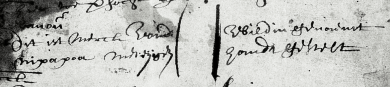
Nipapoa signed with a mark consisting of two vertical lines.[5]
Enslavement
Offices
Nipapoa was probably a female sachem or chieftain, though the known records do not mention her in that role. In her book about The Mohicans [Mahicans] and Their Land, Shirley W. Dunn points out that women who functioned as sachems may not have been identified as such in Dutch records, since the Dutch were unaware of their positions.[6] Nipapoa’s ownership of the island and appearance as seller in the 1661 deed suggests a leadership position.
Several authors portray Nipapoa as a sachem. In his 1899 history of Ulster County, Augustus H. Van Buren called Nipapoa a “chieftainess” of a band of the Catskills, whose wigwam showed the figure of a wolf, the emblem of her tribe.[7] He provided no documentation to support this claim, apart from a reference to the 1661 deed. Nipapoa’s role as a tribal leader seems to have been an inference by Van Buren based on the deed. In 1906, Edward Ruttenber called Nipopoa a “squaw sachem” who reigned “on the north side of the Kat’s Kill . . . in royal majesty” in 1650.[8] Again, no source is cited, though it is possible he embellished on Van Buren’s book and changed the date. Modern publications likewise call Nipapoa a sachem, including Evan T. Pritchard’s book on Native New Yorkers, which calls her a “woman sachem.”[9]
Holdings and Estate
Nipapoa was one of the joint owners of an island called Pachonakellick. On 8 February 1661, three Native American men called Maghsapeet alias Machackniemanauw, Sansewanouwe, and Paneenseen, and a Native American woman called Nipapoa sold their jointly owned island of Pachonakellick to Andries Herbertsen and Rutger Jacobsen, inhabitants of Beverwijck [modern-day Albany]. The island was located in the Hudson River, obliquely across from Betlehem, and was called Long or Mahikanders Island by the Dutch. The transaction took place in the presence of Aepjen and Nietamorit, and was witnessed by Gerrit Bancker and Johannes Provoost.[10]
The deed originally only included her name as the seller. The three Native American men were added in a note in the margin.[11] Nipapoa’s prominent position in the deed suggests she was an important woman in her tribe.
In return for the island, Nipapoa and the three men received:
- 6 “koubeerse” [perhaps: cows][12]
- 10 duffel overcoats
- 30 pound “ketels” [kettles]
- 60 “vaem” [measure of about six feet] of sewant
- 10 axes
- 8 adzes
- 2 guns
- 12 pounds of gunpowder
- 30 pounds of lead
- 3 dozen knives
- 12 cans of brandy
- 1 half barrel of beer
- 10 pounds of tobacco.[13]
The New Netherland colonial council confirmed the transaction on 10 March 1661.[14]
The transaction was recorded according to Dutch law, and described the sale in terms of a transfer of personally owned property. How the four Native Americans interpreted the transaction has not been documented.
Associations
Support New Netherland Settlers
Help us support New Netherland Settlers and further more research and additional sketches.
Do you have a New Netherland ancestor that should be included or other information to contribute to the initiative? Please email development@nygbs.org with the subject line "NNS Information," and we will follow up with you.
Nipapoa jointly owned the island with Maghsapeet alias Machackniemanauw, Sansewanouwe, and Paneenseen. She also knew Aepjen and Nietamorit, who were present when the transaction was recorded.[15] It is unknown whether Nipapoa was related to these men. Nipapoa would also have met the buyers of the island, Andries Herbertsen and Rutger Jacobsen, and Gerrit Bancker and Johannes Provoost who witnessed the signing of the deed.
Literature
Dunn, Shirley W. The Mohicans and Their Land, 1609–1730. Bovina, New York: Purple Mountain Press, 1994. Especially “Women as Sachems,” pages 248–51.
Huey, Paul R. “The Mahicans, the Dutch, and the Schodack Islands in the 17th and 18th Centuries.” Northeast Historical Archaeology 22, no. 1 (1993): 96–118. https://doi.org/10.22191/neha/vol22/iss1/7. This discusses transactions involving islands in the Hudson River, including the 1661 sale of Pachonakellick.
Pritchard, Evan T. Native New Yorkers: The Legacy of the Algonquin People of New York. San Francisco, California: Council Oak Books, 2002. Discusses Nipapoa in the sections for Ulster county (pp. 237–240) and Greene county (pp. 297–301).
Van Buren, Augustus. A History of Ulster County under the Dominion of the Dutch. Kingston, New York, 1923. Discusses Nipapoa in a segment about Native American women in leadership roles (p. 10). His claim that she was a chieftainess over a band of the Catskills is undocumented.
Source Editions
Fernow, B., ed. and transl. Documents Relating to the History and Settlements of the Towns along the Hudson and Mohawk Rivers (with the Exception of Albany) from 1630 to 1684. Documents Relating to the Colonial History of the State of New York. Albany, New York: Weed, Parsons and Company, 1881. Vol. 13:193 has a translation of the Indian deed in the Dutch colonial council minutes and note about the goods received in exchange for the island.
Gehring, Charles T., ed. Land Papers, Volumes GG, HH & II, 1630–1664. Baltimore, Maryland: Genealogical Publishing, 1980. HH 122 (p. 101) has a translation of the patent to Andries Herpertsz and Rutger Jacobsen.
Gehring, Charles T. and Janny Venema, eds. Fort Orange Records, 1654–1679. Syracuse, New York: Syracuse University Press, 2009. Pages 179–80 has the translation of the “Conveyance of an island from its Indian owners to Anderies Herbertsen and Rutger Jacobsen.”
Pearson, Jonathan, and Arnold J. F. (Arnold Johan Ferdinand) Van Laer, eds. Early Records of the City and County of Albany, and Colony of Rensselaerswyck, Deeds 1656-1675. 4 vols. Albany: The University of the State of New York, 1869. Vol. 1:291–92 has the translation of the 1661 deed.
Citations
[1] Conveyance of Pachonakellick island, 8 February 1661, in Fort Orange and Beverwijck, deeds and wills, vol. 2, 1654–1680, p. 285; imaged, FamilySearch (https://www.familysearch.org/ark:/61903/3:1:3QS7-99W7-LR78), image group no. 007121132, image 151 of 459; citing County Albany, New York. A copy was recorded in the Dutch colonial council minutes. Indian deed of Pachonakellick island to Andries Herpertsen and Rutger Jacobsen, 8 February 1661, in New Netherland Council, Dutch colonial council minutes, vol. 9, 1660–1661, pp. 553–54; imaged, “Digital Collections,” New York State Archives (https://digitalcollections.archives.nysed.gov/index.php/Detail/objects/53722), identifier NYSA_A1809-78_V09_0553; citing series A1809, New York State Archives, Albany, New York.
[2] Evan T. Pritchard, Native New Yorkers: The Legacy of the Algonquin People of New York (San Francisco, California: Council Oak Books, 2002), 240, 297.
[3] Conveyance of Pachonakellick island, 8 February 1661.
[4] Conveyance of Pachonakellick island, 8 February 1661.
[5] Conveyance of Pachonakellick island, 8 February 1661.
[6] Shirley W Dunn, The Mohicans and Their Land, 1609–1730 (Bovina, New York: Purple Mountain Press, 1994), 249.
[7] Augustus Van Buren, A History of Ulster County under the Dominion of the Dutch (Kingston, New York, 1923), 10.
[8] Edward Manning Ruttenber, Footprints of the Red Men. Indian Geographical Names in the Valley of Hudson’s River, the Valley of the Mohawk, and on the Delaware: Their Location and the Probable Meaning of Some of Them (New York State Historical Association, 1906), 171.
[9] Evan T. Pritchard, Native New Yorkers: The Legacy of the Algonquin People of New York (San Francisco, California: Council Oak Books, 2002), 240.
[10] Conveyance of Pachonakellick island, 8 February 1661.
[11] Conveyance of Pachonakellick island, 8 February 1661.
[12] The original says “koubeerse” which resembles the Dutch “koebeeste,” or cows. Fernow translated the term as “rugs.” B. Fernow, ed. and transl., Documents Relating to the History and Settlements of the Towns along the Hudson and Mohawk Rivers (with the Exception of Albany) from 1630 to 1684, Documents Relating to the Colonial History of the State of New York 13 (Albany, New York: Weed, Parsons and Company, 1881), 193.
[13] Indian deed of Pachonakellick island to Andries Herpertsen and Rutger Jacobsen, 8 February 1661.
[14] Patent to Andries Herpertsen and Rutger Jacobsen for island Packonakellick, 10 March 1661, in New Netherland Council, Dutch colonial patents and deeds, 1630–1664, volume HH, p. 122; imaged, “Digital Collections,” New York State Archives (https://digitalcollections.archives.nysed.gov/index.php/Detail/objects/51522), identifier NYSA_A1880-78_VHHpt2_0122; citing series A1880, New York State Archives.
[15] Resolution to grant Andries Herperts a small island in Hudson’s river, 10 March 1661, in in New Netherland Council, Dutch colonial council minutes, vol. 9, 1660–1661, p. 552; imaged, “Digital Collections,” New York State Archives (https://digitalcollections.archives.nysed.gov/index.php/Detail/objects/53721), identifier NYSA_A1809-78_V09_0552; citing series A1809, New York State Archives, Albany, New York.
New Netherland Settlers is made possible by donations from organizations and individuals. For more information on how to support the project, email development@nygbs.org.